How to arrange furniture around a fireplace
When a room has a fireplace, we naturally gravitate towards it.
Electric fires and gas appliances become such a focal point that, as soon as they’re installed, you’ll wonder how you ever lived without one. With that said, figuring out exactly where to put the sofa can be a headache.
For many of us, the living room is a place to socialise with family, catch up with TV or curl up with a good book. So, do you point the furniture at the beautiful new fireplace, or towards the TV? Most importantly, how can you do both without giving yourself a stiff neck?
Knowing how to arrange furniture around a fireplace means taking a good, hard look at your space. But, before we get to that, there’s one critical factor that needs to dictate your floor plan above all else: safety.
What does HETAS guidance say?
1. The distance to combustibles rule
It’s easy to forget, but furniture counts as combustible material.
When a HETAS engineer installs your fire, they are trained to follow the manufacturer’s specific minimum distance to combustibles – something, as a homeowner, you should pay attention to, too.
In the eyes of safety regulations, new linen curtains or an oak coffee table are the same as a pile of logs. If they’re placed inside the danger zone, the radiant heat can cause materials to dry out, warp, or, in worst-case scenarios, ignite.
Learning how to arrange furniture around a fireplace means following the calculated safety boundary specific to your model of fire.
2. General ‘rule of thumb’ distances
Visualising where your furniture should go before the fire has been installed can be tricky.
While you must always wait for the specific manual for your chosen fire, HETAS and UK Building Regulations (Approved Document J) offer some standard safety buffers to help you sketch out your floor plan.
- To the front: for a closed appliance (like a wood-burning stove), regulations usually require a non-combustible hearth extending at least 225mm to 300mm in front of the stove door to catch any stray embers. A common recommendation is to keep soft furnishings (like rugs and sofas) at least 800mm to 1 metre away from the front of the fire.
- To the sides: Installation regulations typically require a non-combustible hearth to extend at least 150mm to either side of the stove.
3. Mantle clearance
We all love the look of an oak beam sitting above a wood burner, but heat rises – and it rises fast. If you’re installing a wooden beam or shelf above a freestanding stove, your installer must make sure it isn’t too close to the flue pipe.
Even if the flue is shielded, the heat radiating from the top of the stove is intense, so be sure to consult your manufacturer's recommended vertical clearance.
How to arrange furniture around a fireplace
Now, for the fun stuff! Here’s how to arrange furniture around a fireplace in five different ways.
Option 1: Side-by-side
Best for: Rectangular rooms with a long main wall.
If you have a wide chimney breast or a generous stretch of wall space, placing the TV and fireplace side by side is a great solution. Just place the fireplace in the centre or slightly off-centre. Then, mount the TV on the wall directly beside it, or place it on a low media unit in the alcove.
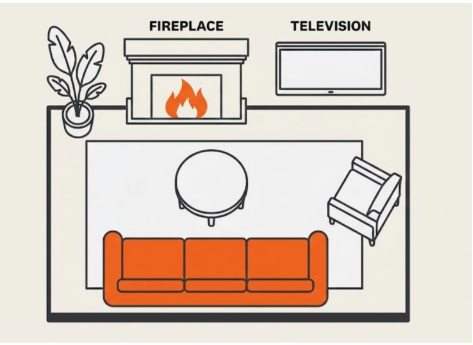
This layout solves the ‘crooked neck’ issue nicely: by orienting your sofa to face the main wall, you can enjoy the crackle of your fireplace and binge-watch your favourite box set simultaneously.
Fires2U design tip: You’re not aiming for symmetry with this layout: TVs, being large, black rectangles, are visually heavy. So, to avoid things feeling lopsided, balance the opposing side with something of equal visual weight, like a potted plant or some Ready to Burn logs.
Option 2: L-shape configuration
Best for: Square rooms or open-plan spaces.
Perhaps the most flexible arrangement for family homes, the L-shape configuration accommodates the need for screen time and cosy fireside chats. Position your main (usually largest) sofa to face the TV, which might be on a wall perpendicular to the fire.
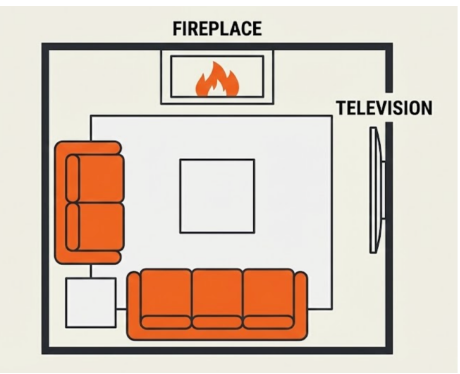
From there, place a couple of armchairs or a smaller loveseat facing the fireplace: this setup creates two distinct zones within one space.
Fires2U design tip: Use a large area rug to anchor the room. We recommend that the rug be large enough for the front legs of all your seating to rest on it, so that the zones work together and don’t feel like separate, floating islands of furniture.
Option 3: Parallel (conversation)
Best for: Formal sitting rooms or spaces without a TV.
If you’re lucky enough to have a separate lounge where the TV isn't the priority, the parallel set-up is a classic configuration (it’s also great for those who love symmetry).
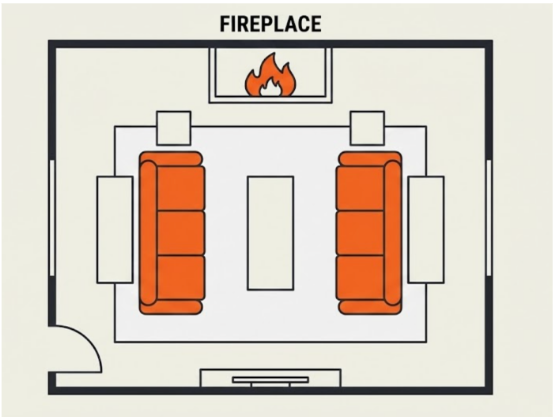
Place two identical sofas facing each other, positioned perpendicular to the fireplace. Alternatively, you can arrange four armchairs in a circle with the fire as the backdrop. But why does it work so well?
This design encourages conversation. With everyone facing each other, you’re drawn in by the fire and discussions with all your favourite people.
Fires2U design tip: A coffee table or a large ottoman in the middle will be necessary here. It’s the perfect spot for resting a tray of tea (or a glass of wine) so that no one has to get up.
Option 4: Corner fire
Best for: Smaller rooms, awkward angles, or open-plan living spaces.
Not every fireplace takes pride of place in the centre of a wall.
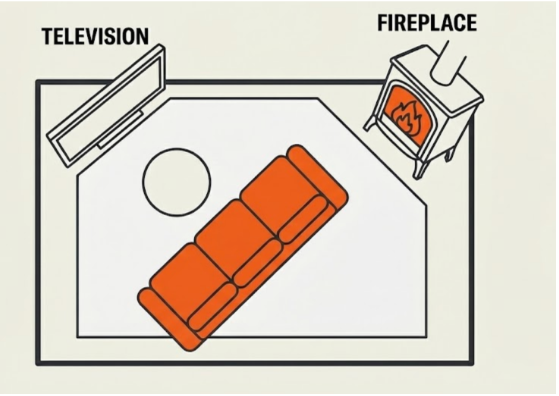
In fact, many installations (particularly those involving freestanding stoves or electric suites) are deliberately tucked into a corner. It’s certainly an excellent way to maximise floor space, but it can present a unique puzzle when it comes to furniture arrangement.
The answer isn’t to push all your chairs into the corner to match: take a ‘soft angle approach’ where, instead of lining everything up against the flat walls (which can make the room feel disjointed from the fire), try angling your main seating pieces slightly.
Orient your sofa so it faces into the main body of the room: it should be positioned with a diagonal sightline to your corner fire. Square-on layouts can sometimes feel rigid, so just remember, no layout is ‘right’: optimal placement will vary house-to-house.
Fires2U design tip: If you have an armchair, try placing it on the opposite side of the room, angled back towards the stove.
Option 5: Double focal point
Best for: Large living rooms, long rectangular spaces, or open-plan family hubs.
Sometimes, we’re blessed with too much space. If you have a particularly large or long living room, you might find yourself in a dilemma: the fireplace is beautiful on one wall, but the only logical place for the TV is on the opposite wall.
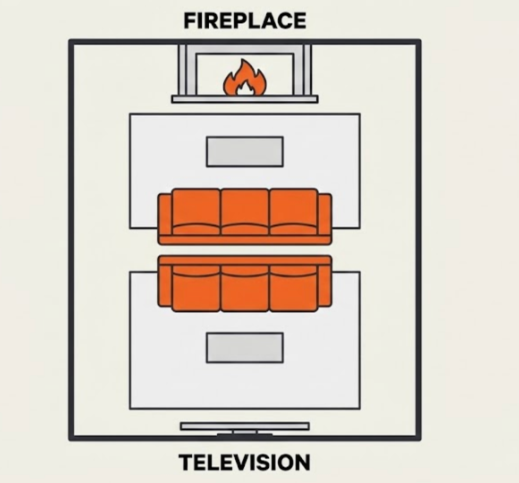
How do you choose which way to look? The answer is, you don’t have to! You just have to zone. For this strategy, treat the space as two distinct but connected areas:
- Divider: For this option, place two sofas back-to-back in the middle of the room. Alternatively, a large L-shaped or U-shaped sectional can act as a natural room divider.
- Zone A (quiet zone): Orient one seating area specifically towards your fireplace. At a safe distance, add a coffee table and a reading lamp: this is your new sanctuary for quiet time by the fire!
- Zone B (entertainment zone: The other half of the room faces the TV; this is where you’ll host movie nights and catch up on box sets.
Shop for electric and gas fireplaces with Fires2U!
Now that you know how to arrange furniture around a fireplace, it’s time to start shopping.
Every room has a unique shape, so we stock a massive range of gas and electric fires to suit your lifestyle. Consider DRU, masters of engineering, or a model from Elgin & Hall. We also offer beautiful stoves from Celsi and high-efficiency gas fires, courtesy of Crystal.
Get yours today, and find the fire your home deserves.